Colleges by Location
Colleges by Fields of Study
Colleges by Tuition Range
Colleges by GPA Range
College by SAT Range
Colleges by ACT Score
Graduate Schools by Location
Graduate Schools by Fields of Study
Graduate School by Degree Type
Paying for Graduate School
Online Graduate Programs
Test Preparation
Career Planning
College Planning
Graduate School Planning
Applying to Graduate School
- More

| Median Wage (USD, 2024) | Projected Job Openings (2024-2034) | Projected Growth (2024-2034) | |
|---|---|---|---|
| National Statistics | $59280 | 1500 | 4.6% |
| State Statistics | - | - | - |
| City Statistics | - | - | - |
Experience Requirements Overview
- Job Zone 1-2: Very Little to Some Preparation Needed
- Some occupations may need little or no previous experience; others require several months to a year of experience. For example, landscaping and groundskeeping workers might require very little training or previous experience, while agricultural equipment operators can benefit from on-the job training.
- Usually requires a high school diploma or GED, though some occupations may not.
- Ranges from a few days to one year of on-the-job training.
Education, Training and Experience
Required Level of Education: Less than a High School Diploma
Related Work Experience: N.A.
On-Site or In-Plant Training: Over 2 years, up to and including 4 years
On-the-Job Training: Over 2 years, up to and including 4 years
Detailed Work Activities
- Install metal structural components.
- Position structural components.
- Install fencing or other barriers.
- Review blueprints or specifications to determine work requirements.
- Position safety or support equipment.
Work Values
Achievement
Occupations that satisfy this work value are results oriented and allow employees to use their strongest abilities, giving them a feeling of accomplishment. Corresponding needs are Ability Utilization and Achievement.
Working Conditions
Recognition
Relationships
Support
Independence
Tasks
- Determine quantities, sizes, shapes, and locations of reinforcing rods from blueprints, sketches, or oral instructions.
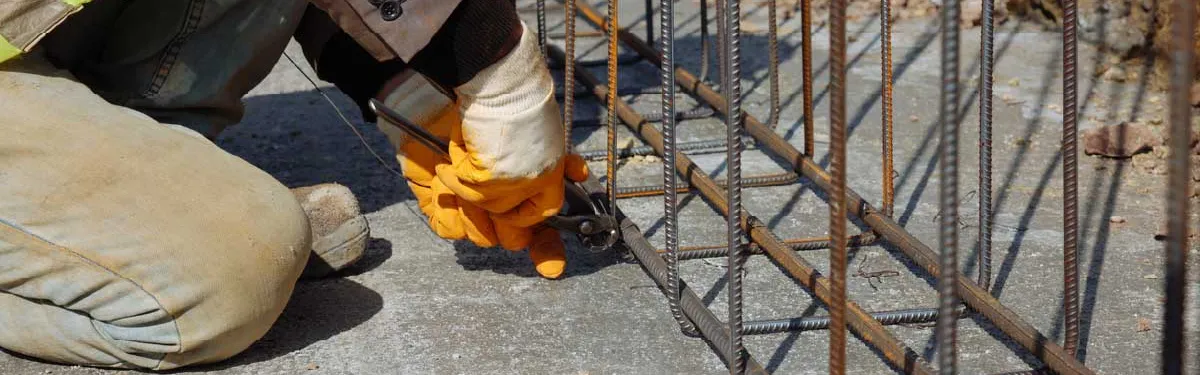
- Space and fasten together rods in forms according to blueprints, using wire and pliers.
- Position and secure steel bars, rods, cables, or mesh in concrete forms, using fasteners, rod-bending machines, blowtorches, or hand tools.
- Cut rods to required lengths, using metal shears, hacksaws, bar cutters, or acetylene torches.
- Place blocks under rebar to hold the bars off the deck when reinforcing floors.
- Cut and fit wire mesh or fabric, using hooked rods, and position fabric or mesh in concrete to reinforce concrete.
- Bend steel rods with hand tools or rod-bending machines and weld them with arc-welding equipment.
Work Styles
Innovation
A tendency to be inventive, to be imaginative, and to adopt new perspectives on ways to accomplish work.
Innovation
Achievement Orientation
Achievement Orientation
Intellectual Curiosity
Intellectual Curiosity
Tolerance for Ambiguity
Tolerance for Ambiguity
Initiative
Initiative
Adaptability
Adaptability
Self-Confidence
Self-Confidence
Perseverance
Perseverance
Leadership Orientation
Leadership Orientation
Humility
Humility
Sincerity
Sincerity
Empathy
Empathy
Cooperation
Cooperation
Optimism
Optimism
Social Orientation
Social Orientation
Cautiousness
Cautiousness
Attention to Detail
Attention to Detail
Dependability
Dependability
Integrity
Integrity
Stress Tolerance
Stress Tolerance
Self-Control
Self-Control
Data Source: This page includes information from the O*NET 30.0 Database by the U.S. Department of Labor, Employment and Training Administration (USDOL/ETA). Used under the CC BY 4.0 license. O*NET® is a trademark of USDOL/ETA. This page includes Employment Projections program, Occupational Employment and Wage Statistics program, U.S. Bureau of Labor Statistics.