Colleges by Location
Colleges by Fields of Study
Colleges by Tuition Range
Colleges by GPA Range
College by SAT Range
Colleges by ACT Score
Graduate Schools by Location
Graduate Schools by Fields of Study
Graduate School by Degree Type
Paying for Graduate School
Online Graduate Programs
Test Preparation
Career Planning
College Planning
Graduate School Planning
Applying to Graduate School
- More

| Median Wage (USD, 2024) | Projected Job Openings (2024-2034) | Projected Growth (2024-2034) | |
|---|---|---|---|
| National Statistics | $53900 | 700 | -7.3% |
| State Statistics | - | - | - |
| City Statistics | - | - | - |
Experience Requirements Overview
- Job Zone 1-2: Very Little to Some Preparation Needed
- Some occupations may need little or no previous experience; others require several months to a year of experience. For example, landscaping and groundskeeping workers might require very little training or previous experience, while agricultural equipment operators can benefit from on-the job training.
- Usually requires a high school diploma or GED, though some occupations may not.
- Ranges from a few days to one year of on-the-job training.
Education, Training and Experience
Required Level of Education: Less than a High School Diploma
Related Work Experience: Over 4 years, up to and including 6 years
On-Site or In-Plant Training: N.A.
On-the-Job Training: Anything beyond short demonstration, up to and including 1 month
Detailed Work Activities
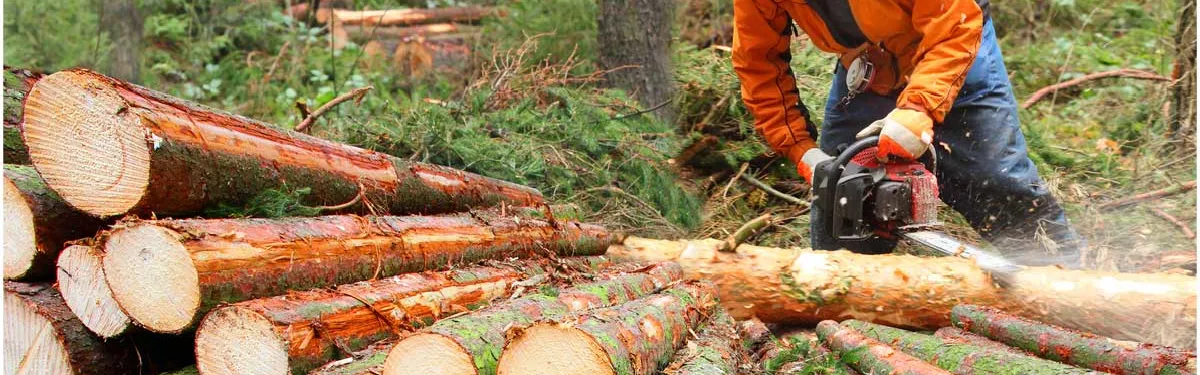
- Cut trees or logs.
- Operate forestry equipment.
- Evaluate quality of plants or crops.
- Trim trees or other vegetation.
- Measure physical characteristics of forestry or agricultural products.
Work Values
Achievement
Occupations that satisfy this work value are results oriented and allow employees to use their strongest abilities, giving them a feeling of accomplishment. Corresponding needs are Ability Utilization and Achievement.
Working Conditions
Recognition
Relationships
Support
Independence
Tasks
- Stop saw engines, pull cutting bars from cuts, and run to safety as tree falls.
- Appraise trees for certain characteristics, such as twist, rot, and heavy limb growth, and gauge amount and direction of lean, to determine how to control the direction of a tree's fall with the least damage.
- Saw back-cuts, leaving sufficient sound wood to control direction of fall.
- Clear brush from work areas and escape routes, and cut saplings and other trees from direction of falls, using axes, chainsaws, or bulldozers.
- Measure felled trees and cut them into specified log lengths, using chain saws and axes.
- Assess logs after cutting to ensure that the quality and length are correct.
- Determine position, direction, and depth of cuts to be made, and placement of wedges or jacks.
- Control the direction of a tree's fall by scoring cutting lines with axes, sawing undercuts along scored lines with chainsaws, knocking slabs from cuts with single-bit axes, and driving wedges.
- Trim off the tops and limbs of trees, using chainsaws, delimbers, or axes.
- Select trees to be cut down, assessing factors such as site, terrain, and weather conditions before beginning work.
- Maintain and repair chainsaws and other equipment, cleaning, oiling, and greasing equipment, and sharpening equipment properly.
- Insert jacks or drive wedges behind saws to prevent binding of saws and to start trees falling.
- Tag unsafe trees with high-visibility ribbons.
- Secure steel cables or chains to logs for dragging by tractors or for pulling by cable yarding systems.
- Load logs or wood onto trucks, trailers, or railroad cars, by hand or using loaders or winches.
- Mark logs for identification.
- Work as a member of a team, rotating between chain saw operation and skidder operation.
- Place supporting limbs or poles under felled trees to avoid splitting undersides, and to prevent logs from rolling.
Work Styles
Innovation
A tendency to be inventive, to be imaginative, and to adopt new perspectives on ways to accomplish work.
Innovation
Achievement Orientation
Achievement Orientation
Intellectual Curiosity
Intellectual Curiosity
Tolerance for Ambiguity
Tolerance for Ambiguity
Initiative
Initiative
Adaptability
Adaptability
Self-Confidence
Self-Confidence
Perseverance
Perseverance
Leadership Orientation
Leadership Orientation
Humility
Humility
Sincerity
Sincerity
Empathy
Empathy
Cooperation
Cooperation
Optimism
Optimism
Social Orientation
Social Orientation
Cautiousness
Cautiousness
Attention to Detail
Attention to Detail
Dependability
Dependability
Integrity
Integrity
Stress Tolerance
Stress Tolerance
Self-Control
Self-Control
Data Source: This page includes information from the O*NET 30.0 Database by the U.S. Department of Labor, Employment and Training Administration (USDOL/ETA). Used under the CC BY 4.0 license. O*NET® is a trademark of USDOL/ETA. This page includes Employment Projections program, Occupational Employment and Wage Statistics program, U.S. Bureau of Labor Statistics.