Colleges by Location
Colleges by Fields of Study
Colleges by Tuition Range
Colleges by GPA Range
College by SAT Range
Colleges by ACT Score
Graduate Schools by Location
Graduate Schools by Fields of Study
Graduate School by Degree Type
Paying for Graduate School
Online Graduate Programs
Test Preparation
Career Planning
College Planning
Graduate School Planning
Applying to Graduate School
- More

| Median Wage (USD, 2024) | Projected Job Openings (2024-2034) | Projected Growth (2024-2034) | |
|---|---|---|---|
| National Statistics | $132170 | 100 | 2.2% |
| State Statistics | - | - | - |
| City Statistics | - | - | - |
Experience Requirements Overview
- Job Zone Five: Extensive Preparation Needed
- Extensive skill, knowledge, and experience are needed for these occupations. Many require more than five years of experience. For example, surgeons must complete four years of college and an additional five to seven years of specialized medical training to be able to do their job.
- Most of these occupations require graduate school. For example, they may require a master's degree, and some require a Ph.D., M.D., or J.D. (law degree).
- Employees may need some on-the-job training, but most of these occupations assume that the person will already have the required skills, knowledge, work-related experience, and/or training.
Education, Training and Experience
Required Level of Education: Doctoral Degree
Related Work Experience: Over 2 years, up to and including 4 years
On-Site or In-Plant Training: N.A.
On-the-Job Training: Anything beyond short demonstration, up to and including 1 month
Detailed Work Activities
- Review professional literature to maintain professional knowledge.
- Serve on institutional or departmental committees.
- Support the professional development of others.
- Advise students on academic or career matters.
- Supervise student research or internship work.
Work Values
Achievement
Occupations that satisfy this work value are results oriented and allow employees to use their strongest abilities, giving them a feeling of accomplishment. Corresponding needs are Ability Utilization and Achievement.
Working Conditions
Recognition
Relationships
Support
Independence
Tasks
- Analyze research data to determine its significance, using computers.
- Present research findings at scientific conferences and in papers written for scientific journals.
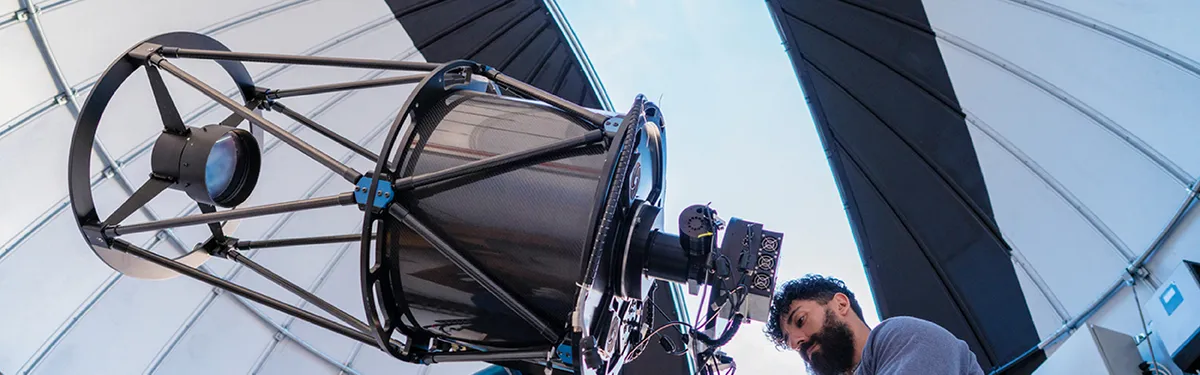
- Study celestial phenomena, using a variety of ground-based and space-borne telescopes and scientific instruments.
- Collaborate with other astronomers to carry out research projects.
- Mentor graduate students and junior colleagues.
- Supervise students' research on celestial and astronomical phenomena.
- Teach astronomy or astrophysics.
- Develop theories based on personal observations or on observations and theories of other astronomers.
- Measure radio, infrared, gamma, and x-ray emissions from extraterrestrial sources.
- Develop instrumentation and software for astronomical observation and analysis.
- Review scientific proposals and research papers.
- Raise funds for scientific research.
- Develop and modify astronomy-related programs for public presentation.
- Serve on professional panels and committees.
- Calculate orbits and determine sizes, shapes, brightness, and motions of different celestial bodies.
- Conduct question-and-answer presentations on astronomy topics with public audiences.
- Direct the operations of a planetarium.
Work Styles
Innovation
A tendency to be inventive, to be imaginative, and to adopt new perspectives on ways to accomplish work.
Innovation
Achievement Orientation
Achievement Orientation
Intellectual Curiosity
Intellectual Curiosity
Tolerance for Ambiguity
Tolerance for Ambiguity
Initiative
Initiative
Adaptability
Adaptability
Self-Confidence
Self-Confidence
Perseverance
Perseverance
Leadership Orientation
Leadership Orientation
Humility
Humility
Sincerity
Sincerity
Empathy
Empathy
Cooperation
Cooperation
Optimism
Optimism
Social Orientation
Social Orientation
Cautiousness
Cautiousness
Attention to Detail
Attention to Detail
Dependability
Dependability
Integrity
Integrity
Stress Tolerance
Stress Tolerance
Self-Control
Self-Control
Data Source: This page includes information from the O*NET 30.0 Database by the U.S. Department of Labor, Employment and Training Administration (USDOL/ETA). Used under the CC BY 4.0 license. O*NET® is a trademark of USDOL/ETA. This page includes Employment Projections program, Occupational Employment and Wage Statistics program, U.S. Bureau of Labor Statistics.