Colleges by Location
Colleges by Fields of Study
Colleges by Tuition Range
Colleges by GPA Range
College by SAT Range
Colleges by ACT Score
Graduate Schools by Location
Graduate Schools by Fields of Study
Graduate School by Degree Type
Paying for Graduate School
Online Graduate Programs
Test Preparation
Career Planning
College Planning
Graduate School Planning
Applying to Graduate School
- More

| Median Wage (USD, 2024) | Projected Job Openings (2024-2034) | Projected Growth (2024-2034) | |
|---|---|---|---|
| National Statistics | $48940 | 600 | -4.7% |
| State Statistics | - | - | - |
| City Statistics | - | - | - |
Experience Requirements Overview
- Job Zone 1-2: Very Little to Some Preparation Needed
- Some occupations may need little or no previous experience; others require several months to a year of experience. For example, landscaping and groundskeeping workers might require very little training or previous experience, while agricultural equipment operators can benefit from on-the job training.
- Usually requires a high school diploma or GED, though some occupations may not.
- Ranges from a few days to one year of on-the-job training.
Education, Training and Experience
Required Level of Education: High School Diploma - or the equivalent (for example, GED)
Related Work Experience: N.A.
On-Site or In-Plant Training: Over 3 months, up to and including 6 months
On-the-Job Training: Over 3 months, up to and including 6 months
Detailed Work Activities
- Collect samples of materials or products for testing.
- Signal others to coordinate work activities.
- Place materials into molds.
- Adjust equipment controls to regulate flow of production materials or products.
- Monitor instruments to ensure proper production conditions.
Work Values
Achievement
Occupations that satisfy this work value are results oriented and allow employees to use their strongest abilities, giving them a feeling of accomplishment. Corresponding needs are Ability Utilization and Achievement.
Working Conditions
Recognition
Relationships
Support
Independence
Tasks
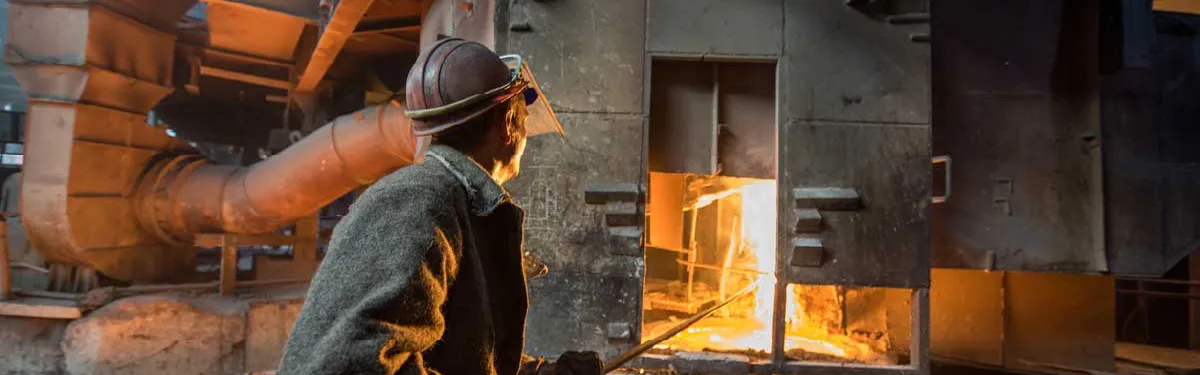
- Pour and regulate the flow of molten metal into molds and forms to produce ingots or other castings, using ladles or hand-controlled mechanisms.
- Read temperature gauges and observe color changes, adjusting furnace flames, torches, or electrical heating units as necessary to melt metal to specifications.
- Remove solidified steel or slag from pouring nozzles, using long bars or oxygen burners.
- Examine molds to ensure they are clean, smooth, and properly coated.
- Collect samples, or signal workers to sample metal for analysis.
- Load specified amounts of metal and flux into furnaces or clay crucibles.
- Position equipment such as ladles, grinding wheels, pouring nozzles, or crucibles, or signal other workers to position equipment.
- Skim slag or remove excess metal from ingots or equipment, using hand tools, strainers, rakes, or burners, collecting scrap for recycling.
- Transport metal ingots to storage areas, using forklifts.
- Assemble and embed cores in casting frames, using hand tools and equipment.
- Turn valves to circulate water through cores, or spray water on filled molds to cool and solidify metal.
- Pull levers to lift ladle stoppers and to allow molten steel to flow into ingot molds to specified heights.
- Remove metal ingots or cores from molds, using hand tools, cranes, and chain hoists.
- Repair and maintain metal forms and equipment, using hand tools, sledges, and bars.
- Add metal to molds to compensate for shrinkage.
- Stencil identifying information on ingots and pigs, using special hand tools.
Work Styles
Innovation
A tendency to be inventive, to be imaginative, and to adopt new perspectives on ways to accomplish work.
Innovation
Achievement Orientation
Achievement Orientation
Intellectual Curiosity
Intellectual Curiosity
Tolerance for Ambiguity
Tolerance for Ambiguity
Initiative
Initiative
Adaptability
Adaptability
Self-Confidence
Self-Confidence
Perseverance
Perseverance
Leadership Orientation
Leadership Orientation
Humility
Humility
Sincerity
Sincerity
Empathy
Empathy
Cooperation
Cooperation
Optimism
Optimism
Social Orientation
Social Orientation
Cautiousness
Cautiousness
Attention to Detail
Attention to Detail
Dependability
Dependability
Integrity
Integrity
Stress Tolerance
Stress Tolerance
Self-Control
Self-Control
Data Source: This page includes information from the O*NET 30.0 Database by the U.S. Department of Labor, Employment and Training Administration (USDOL/ETA). Used under the CC BY 4.0 license. O*NET® is a trademark of USDOL/ETA. This page includes Employment Projections program, Occupational Employment and Wage Statistics program, U.S. Bureau of Labor Statistics.