Colleges by Location
Colleges by Fields of Study
Colleges by Tuition Range
Colleges by GPA Range
College by SAT Range
Colleges by ACT Score
Graduate Schools by Location
Graduate Schools by Fields of Study
Graduate School by Degree Type
Paying for Graduate School
Online Graduate Programs
Test Preparation
Career Planning
College Planning
Graduate School Planning
Applying to Graduate School
- More

| Median Wage (USD, 2024) | Projected Job Openings (2024-2034) | Projected Growth (2024-2034) | |
|---|---|---|---|
| National Statistics | $40440 | 6400 | -1.8% |
| State Statistics | - | - | - |
| City Statistics | - | - | - |
Experience Requirements Overview
- Job Zone 1-2: Very Little to Some Preparation Needed
- Some occupations may need little or no previous experience; others require several months to a year of experience. For example, landscaping and groundskeeping workers might require very little training or previous experience, while agricultural equipment operators can benefit from on-the job training.
- Usually requires a high school diploma or GED, though some occupations may not.
- Ranges from a few days to one year of on-the-job training.
Education, Training and Experience
Required Level of Education: High School Diploma - or the equivalent (for example, GED)
Related Work Experience: Over 3 months, up to and including 6 months
On-Site or In-Plant Training: N.A.
On-the-Job Training: Anything beyond short demonstration, up to and including 1 month
Detailed Work Activities
- Conduct test runs of production equipment.
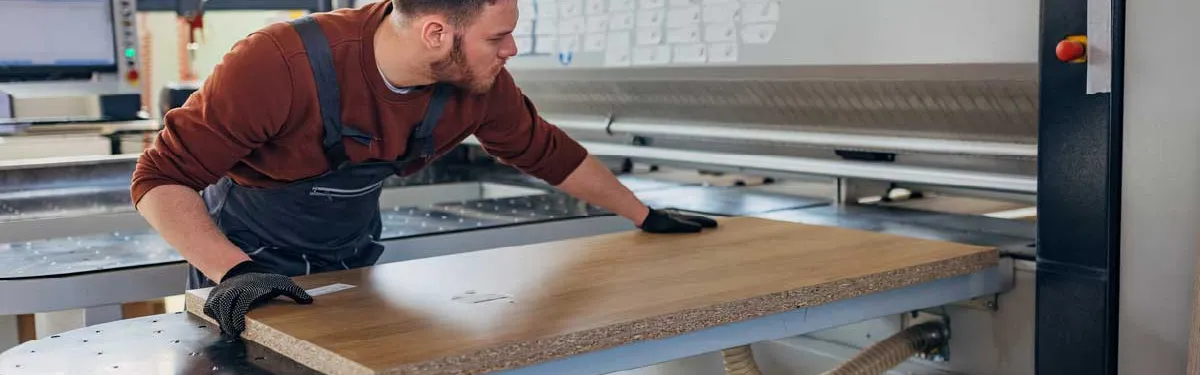
- Operate woodworking equipment.
- Determine production equipment settings.
- Select production input materials.
- Feed materials or products into or through equipment.
Work Values
Achievement
Occupations that satisfy this work value are results oriented and allow employees to use their strongest abilities, giving them a feeling of accomplishment. Corresponding needs are Ability Utilization and Achievement.
Working Conditions
Recognition
Relationships
Support
Independence
Tasks
- Set up, program, operate, or tend computerized or manual woodworking machines, such as drill presses, lathes, shapers, routers, sanders, planers, or wood-nailing machines.
- Examine finished workpieces for smoothness, shape, angle, depth-of-cut, or conformity to specifications and verify dimensions, visually and using hands, rules, calipers, templates, or gauges.
- Start machines, adjust controls, and make trial cuts to ensure that machinery is operating properly.
- Monitor operation of machines and make adjustments to correct problems and ensure conformance to specifications.
- Examine raw woodstock for defects and to ensure conformity to size and other specification standards.
- Adjust machine tables or cutting devices and set controls on machines to produce specified cuts or operations.
- Install and adjust blades, cutterheads, boring-bits, or sanding-belts, using hand tools and rules.
- Change alignment and adjustment of sanding, cutting, or boring machine guides to prevent defects in finished products, using hand tools.
- Determine product specifications and materials, work methods, and machine setup requirements, according to blueprints, oral or written instructions, drawings, or work orders.
- Feed stock through feed mechanisms or conveyors into planing, shaping, boring, mortising, or sanding machines to produce desired components.
- Push or hold workpieces against, under, or through cutting, boring, or shaping mechanisms.
- Select knives, saws, blades, cutter heads, cams, bits, or belts, according to workpiece, machine functions, or product specifications.
- Remove and replace worn parts, bits, belts, sandpaper, or shaping tools.
- Secure woodstock against a guide or in a holding device, place woodstock on a conveyor, or dump woodstock in a hopper to feed woodstock into machines.
- Inspect and mark completed workpieces and stack them on pallets, in boxes, or on conveyors so that they can be moved to the next workstation.
- Inspect pulleys, drive belts, guards, or fences on machines to ensure that machines will operate safely.
- Clean or maintain products, machines, or work areas.
- Attach and adjust guides, stops, clamps, chucks, or feed mechanisms, using hand tools.
- Trim wood parts according to specifications, using planes, chisels, or wood files or sanders.
- Grease or oil woodworking machines.
- Unclamp workpieces and remove them from machines.
- Start machines and move levers to engage hydraulic lifts that press woodstocks into desired forms and disengage lifts after appropriate drying times.
- Operate gluing machines to glue pieces of wood together, or to press and affix wood veneer to wood surfaces.
- Set up, program, or control computer-aided design (CAD) or computer numerical control (CNC) machines.
- Control hoists to remove parts or products from work stations.
Work Styles
Innovation
A tendency to be inventive, to be imaginative, and to adopt new perspectives on ways to accomplish work.
Innovation
Achievement Orientation
Achievement Orientation
Intellectual Curiosity
Intellectual Curiosity
Tolerance for Ambiguity
Tolerance for Ambiguity
Initiative
Initiative
Adaptability
Adaptability
Self-Confidence
Self-Confidence
Perseverance
Perseverance
Leadership Orientation
Leadership Orientation
Humility
Humility
Sincerity
Sincerity
Empathy
Empathy
Cooperation
Cooperation
Optimism
Optimism
Social Orientation
Social Orientation
Cautiousness
Cautiousness
Attention to Detail
Attention to Detail
Dependability
Dependability
Integrity
Integrity
Stress Tolerance
Stress Tolerance
Self-Control
Self-Control
Data Source: This page includes information from the O*NET 30.0 Database by the U.S. Department of Labor, Employment and Training Administration (USDOL/ETA). Used under the CC BY 4.0 license. O*NET® is a trademark of USDOL/ETA. This page includes Employment Projections program, Occupational Employment and Wage Statistics program, U.S. Bureau of Labor Statistics.