Colleges by Location
Colleges by Fields of Study
Colleges by Tuition Range
Colleges by GPA Range
College by SAT Range
Colleges by ACT Score
Graduate Schools by Location
Graduate Schools by Fields of Study
Graduate School by Degree Type
Paying for Graduate School
Online Graduate Programs
Test Preparation
Career Planning
College Planning
Graduate School Planning
Applying to Graduate School
- More

| Median Wage (USD, 2024) | Projected Job Openings (2024-2034) | Projected Growth (2024-2034) | |
|---|---|---|---|
| National Statistics | $122670 | 6600 | 5.1% |
| State Statistics | - | - | - |
| City Statistics | - | - | - |
Experience Requirements Overview
- Job Zone Three: Medium Preparation Needed
- Previous work-related skill, knowledge, or experience is required for these occupations. For example, an electrician must have completed three or four years of apprenticeship or several years of vocational training, and often must have passed a licensing exam, in order to perform the job.
- Most occupations in this zone require training in vocational schools, related on-the-job experience, or an associate's degree.
- Employees in these occupations usually need one or two years of training involving both on-the-job experience and informal training with experienced workers. A recognized apprenticeship program may be associated with these occupations.
Education, Training and Experience
Required Level of Education: Post-Secondary Certificate - awarded for training completed after high school (for example, in agriculture or natural resources, computer services, personal or culinary services, engineering technologies, healthcare, construction trades, mechanic and repair technologies, or precision production)
Related Work Experience: Over 2 years, up to and including 4 years
On-Site or In-Plant Training: Over 1 month, up to and including 3 months
On-the-Job Training: Anything beyond short demonstration, up to and including 1 month
Detailed Work Activities
- Inspect aircraft or aircraft components.
- Communicate with others to coordinate vehicle movement.
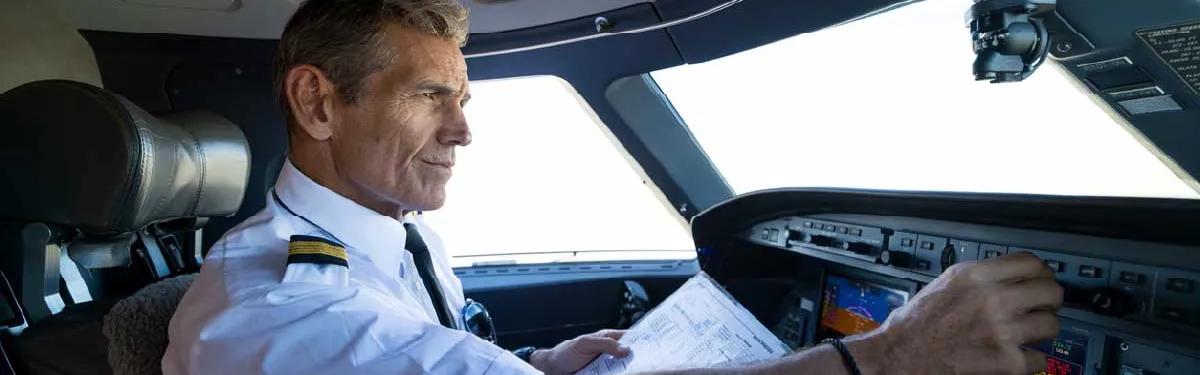
- Pilot aircraft.
- Monitor engine operation or functioning.
- Choose optimal transportation routes or speeds.
Work Values
Achievement
Occupations that satisfy this work value are results oriented and allow employees to use their strongest abilities, giving them a feeling of accomplishment. Corresponding needs are Ability Utilization and Achievement.
Working Conditions
Recognition
Relationships
Support
Independence
Tasks
- Check aircraft prior to flights to ensure that the engines, controls, instruments, and other systems are functioning properly.
- Co-pilot aircraft or perform captain's duties, as required.
- Consider airport altitudes, outside temperatures, plane weights, and wind speeds and directions to calculate the speed needed to become airborne.
- Use instrumentation to pilot aircraft when visibility is poor.
- Monitor engine operation, fuel consumption, and functioning of aircraft systems during flights.
- Order changes in fuel supplies, loads, routes, or schedules to ensure safety of flights.
- Contact control towers for takeoff clearances, arrival instructions, and other information, using radio equipment.
- Plan flights according to government and company regulations, using aeronautical charts and navigation instruments.
- Start engines, operate controls, and pilot airplanes to transport passengers, mail, or freight according to flight plans, regulations, and procedures.
- Check baggage or cargo to ensure that it has been loaded correctly.
- Obtain and review data such as load weights, fuel supplies, weather conditions, and flight schedules to determine flight plans and identify needed changes.
- Conduct in-flight tests and evaluations at specified altitudes and in all types of weather to determine the receptivity and other characteristics of equipment and systems.
- Choose routes, altitudes, and speeds that will provide the fastest, safest, and smoothest flights.
- Write specified information in flight records, such as flight times, altitudes flown, and fuel consumption.
- Coordinate flight activities with ground crews and air traffic control, and inform crew members of flight and test procedures.
- Perform minor aircraft maintenance and repair work, or arrange for major maintenance.
- Supervise other crew members.
- Request changes in altitudes or routes as circumstances dictate.
- File instrument flight plans with air traffic control so that flights can be coordinated with other air traffic.
- Rescue and evacuate injured persons.
- Instruct other pilots and student pilots in aircraft operations.
- Fly with other pilots or pilot-license applicants to evaluate their proficiency.
- Plan and formulate flight activities and test schedules and prepare flight evaluation reports.
- Teach company regulations and procedures to other pilots.
Work Styles
Innovation
A tendency to be inventive, to be imaginative, and to adopt new perspectives on ways to accomplish work.
Innovation
Achievement Orientation
Achievement Orientation
Intellectual Curiosity
Intellectual Curiosity
Tolerance for Ambiguity
Tolerance for Ambiguity
Initiative
Initiative
Adaptability
Adaptability
Self-Confidence
Self-Confidence
Perseverance
Perseverance
Leadership Orientation
Leadership Orientation
Humility
Humility
Sincerity
Sincerity
Empathy
Empathy
Cooperation
Cooperation
Optimism
Optimism
Social Orientation
Social Orientation
Cautiousness
Cautiousness
Attention to Detail
Attention to Detail
Dependability
Dependability
Integrity
Integrity
Stress Tolerance
Stress Tolerance
Self-Control
Self-Control
Data Source: This page includes information from the O*NET 30.0 Database by the U.S. Department of Labor, Employment and Training Administration (USDOL/ETA). Used under the CC BY 4.0 license. O*NET® is a trademark of USDOL/ETA. This page includes Employment Projections program, Occupational Employment and Wage Statistics program, U.S. Bureau of Labor Statistics.